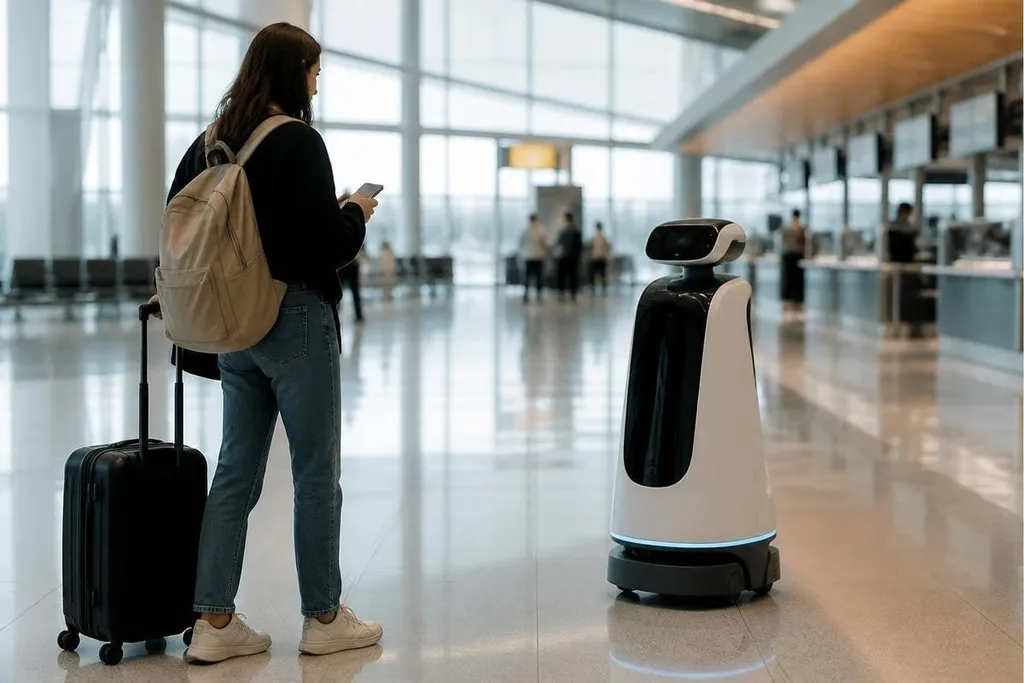
An airport robot could save a passenger from a long walk, a missed turn, or a search for help. The useful test is narrow: does it remove a task that slows people down without adding another machine to understand?
- Wayfinding: A mobile robot could guide passengers to gates, desks, and exits.
- Information: A screen, speaker, and translation system could answer routine questions.
- Terminal work: Cleaning, delivery, and inspection robots could handle tasks away from busy walkways.
Start with the places passengers lose time
Airports contain many small delays. A passenger may need to find a check-in desk, confirm a gate, locate a lift, or reach a new terminal after a gate change.
With a map, cameras, and LiDAR, a robot could move through the building and give directions at the point where the question comes up.
LiDAR measures distance with light pulses. In a mobile robot, it can help build a map and detect people, walls, luggage, and other objects. The robot still needs updated airport data, since a closed corridor or moved gate can make an old route wrong.
That limit matters. A printed sign stays where it was placed, while a robot can change its answer when staff update the route. The airport would need a clear process for checking those updates before the robot sends passengers across a terminal.
Give routine questions a physical place
Passengers often ask for information that follows a set pattern: where to check in, how to reach a gate, where to find food, or which desk handles a problem. Routine questions could be answered through a screen, speech, or a link to the passenger’s phone.
The design has to work for people carrying bags, wearing headphones, speaking different languages, or moving through a noisy hall. A large screen and clear text may help when speech recognition fails. A human staff member should remain easy to reach when the question falls outside the robot’s stored answers.
An airport robot has to help without making passengers stop for a second problem. The airport, task, trial date, and staff handoffs matter when you read airport robotics reporting from Robot24.com and judge whether the machine helps people keep moving.
Use robots where people do not need to stop
Passenger-facing robots draw attention, but back-of-house machines may improve a trip in quieter ways. They could move supplies between airport areas, inspect a floor after a spill, or clean during set periods. Those tasks may help staff spend more time with passengers who need a person.
The gains depend on traffic rules. A delivery robot that stops in a narrow corridor creates a new delay. It needs a safe speed, clear warning signals, and a route that keeps luggage carts and wheelchairs moving.
Airport work also changes by time of day. A route that works during a quiet afternoon may fail during a morning departure rush. Operators should measure stopped trips, blocked paths, missed calls for help, and staff time before deciding whether the robot earns its space.
What airports still need to prove
A robot can answer a question and still make the trip worse if passengers cannot tell what it wants them to do. The airport should test the full exchange, from the first approach to the point where the passenger reaches the right desk or gate.
I'd judge an airport robot by the number of problems it removes, not by how human its voice sounds.
The open issue is trust. Passengers need to know what data the robot collects, how long that data stays stored, and who can see it. They also need a clear route to a person when the robot gives a wrong answer.
A practical airport robot checklist
Before a trial, ask:
- Which delay is measured? Set a starting number for walking time, questions, blocked routes, or staff call-outs.
- Who can use it? Check speech, text size, wheelchair access, language support, and help for passengers with visual or hearing needs.
- What happens offline? Plan for lost network access, low battery, blocked corridors, and a closed gate.
- Where does a person take over? Give passengers a visible staff route when the robot cannot answer.
- What data is stored? State the camera, microphone, location, and retention rules before the trial begins.
- When does the trial stop? Set a date and a pass mark based on passenger delays and staff workload.
The next useful airport robot will be the one that makes a specific delay shorter and shows its limits clearly. Until operators publish those measures, the passenger benefit remains a sensible plan to test, not a result to claim.